

If you make candles at home, you know the feeling: you've got your wax, your jars, your fragrance oils, and then you stare at a wall of wicks and have no idea which ones won't drown, soot, or tunnel. I've been there more times than I can count. I'm Marla Quinlan, and I pour soy and coconut-soy container candles in a converted corner of my garage outside Chattanooga. I've sold at one Saturday farmers market booth for about four years, and wick testing is the part of this business I trust the least. So when I ordered the EricX Light 100-piece pre-waxed cotton wick pack, I decided to actually keep notes instead of just hoping.
This review is from months of weekly pours, not one good weekend. I used these wicks in 8-ounce amber jars, 12-ounce mason jars, and a few 4-ounce tins for samples. I poured soy, coconut-soy, and a couple of beeswax pillars in winter. I burned candles on my kitchen counter, on my porch, and at my market booth. Here's what I learned.
The Quick Verdict
A dependable, low-smoke cotton wick that performs well in container candles when you match the size to your jar. Not fancy, not fussy, and a 100-pack lasts a small maker like me the better part of a year.
Amazon Check Today's Price →The 100-pack that got my Saturday pours back on schedule
I bought these wicks on a Tuesday and poured my first test batch that same week. Months later, they're still what I reach for when I need a wick that just behaves.
Amazon Check Today's Price on Amazon →How I've Used It
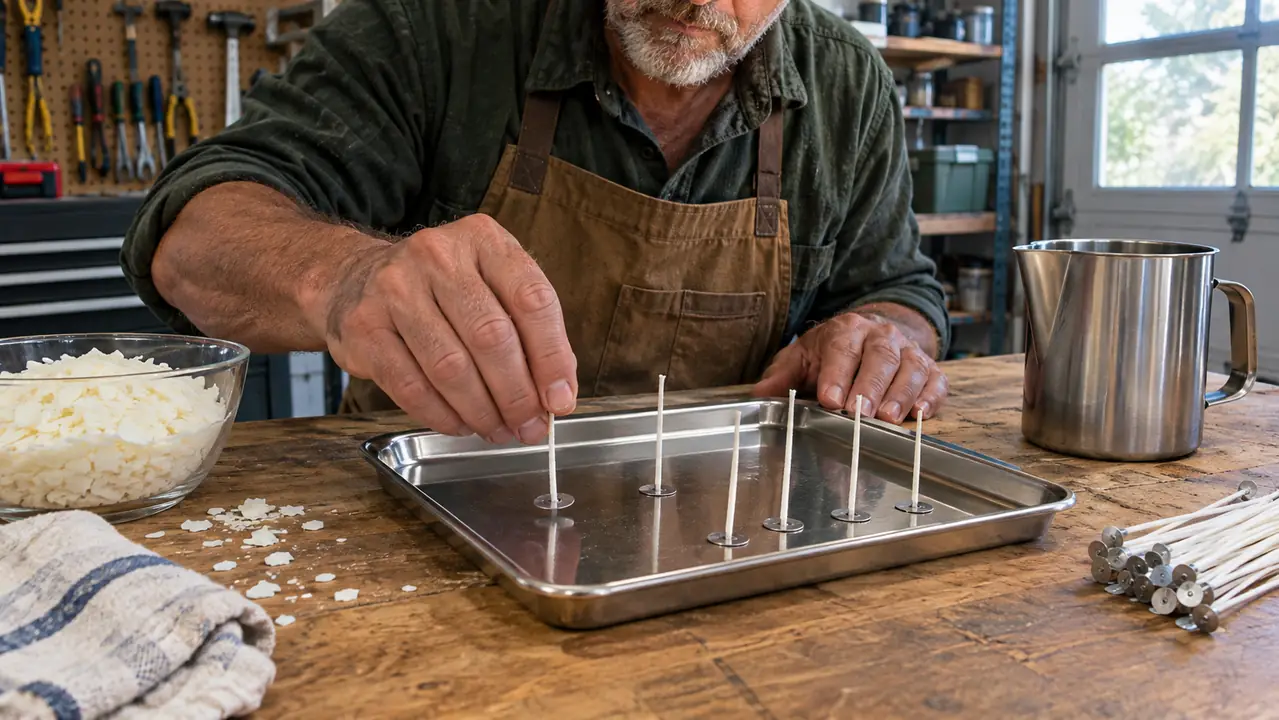
My routine hasn't changed much since I started: I melt wax on a two-burner electric hot plate at my butcher-block folding table, pour into jars, and let them cure on a metal utility shelf. The EricX Light wicks come pre-waxed, which means I can skip the step of dipping them in melted wax before pouring. That sounds small, but when you're pouring 12 jars on a Saturday morning, it saves real time. I timed it once: dipping wicks for a dozen jars used to add about 15 minutes to my setup, and I usually made a mess of the counter doing it. With these, I set the wick in the jar, hold it centered with a wooden skewer laid across the rim, and pour. The whole wick setup for a dozen jars takes me about six minutes now.
I used the size 10 wicks for my 8-ounce amber jars and the size 12 for the 12-ounce mason jars. I also tested a few in 4-ounce tins for market samples. My standard test is a three-hour burn: I light the candle, let it burn for three hours, then check the melt pool, the flame height, and whether the glass is getting too hot. I did that for the first three burns of every jar I poured with these wicks. I keep a spiral notebook on the utility shelf, and every test gets a line: date, jar, wax, fragrance, wick size, melt pool time, flame height, glass temp. By the end of the first month I had 34 lines in that notebook, and the pattern was clear enough that I stopped second-guessing every pour.
The pre-waxed coating held up during shipping. No bent wicks, no crushed packs, no wicks that had snapped in half. That matters more than you'd think, because a bent wick can make a candle burn unevenly from the first light. I didn't have to straighten a single one. The wicks arrived in a flat cardboard sleeve inside the poly bag, and the coating didn't flake or leave residue on my fingers when I handled them. I laid the whole pack out on the butcher block the first night and sorted them by size into labeled sandwich bags, which took about ten minutes and saved me a lot of squinting later.
First Burns and the Learning Curve
My first batch with the EricX Light wicks was a coconut-soy blend in 8-ounce amber jars. I poured at 135 degrees, let them cure for 48 hours, and lit one the next morning. The flame started small and even, and within about 20 minutes I had a full melt pool across the top of the jar. That's the outcome I'm chasing: a complete, even pool without a mushroom on the wick. I wrote '20 minutes to full pool' in my notebook and underlined it, because that almost never happens on the first try with a new wick. I lit a second jar from the same batch that evening to make sure it wasn't a fluke, and it hit a full pool in 22 minutes.
I did get a mushroom on a few wicks during the first week. A mushroom is that little ball of carbon that forms on the tip of a wick when it's burning too hot or the wick is too big for the jar. It's not a disaster, but it can cause soot and a flickering flame. I trimmed the wick to a quarter inch before each burn, and the mushrooms mostly disappeared. On the ones that still formed, I found I'd poured the wax a little hot or used a fragrance oil with a high vanillin content. That's a wax-and-oil issue, not a wick issue. One vanilla-heavy batch at 145 degrees mushroomed on every single wick; the same oil poured at 135 was clean. I tested that same oil at 140 degrees the following week, and it was still clean, so I settled on 135 to 138 as my working range for anything with vanilla.
The low-smoke claim held up in my garage. I burned these candles for hours while I was pouring new batches, and I didn't see black marks on the jars or the ceiling of my garage. I can't promise zero smoke in every drafty room, but in my studio, they were clean. I also left one burning on the porch on a breezy evening, and even with the wind flicking the flame, the wick didn't soot the glass. I checked the rim of the jar with a paper towel the next morning, and it came away clean.
The moment I knew these wicks were keepers: a 12-ounce mason jar burned for three hours, hit a full melt pool in 25 minutes, and left the glass cool enough to touch.
Performance Over Months of Weekly Pours
Consistency is the thing I care about most, because I sell to the same people every Saturday. If a candle burns differently from one jar to the next, I hear about it. Over months of pouring, the EricX Light wicks were consistent. Same size, same wax, same pour temperature, and I got the same burn behavior: a steady flame, a full melt pool, and a clean burn to the end of the jar. I poured the same coconut-soy recipe in the same 8-ounce amber jar six Saturdays in a row, and the melt pool time never varied by more than four minutes. On the sixth batch, I had a customer at the booth ask whether I'd changed anything, because she said the burn seemed even better than the candle she'd bought in the spring.
I did have one jar where the wick burned a little hot and the glass got warmer than I liked. It was a 12-ounce mason jar with a heavy vanilla fragrance oil, and the wick was the size 12. I switched that scent to the size 10 wick and the problem went away. That's not a flaw in the wick; it's the normal wick-sizing dance. You have to match the wick to the wax, the jar, and the fragrance load. I keep a sizing chart taped to the inside of my cabinet door now, and the EricX Light sizes are the reference column on it. When I try a new fragrance, I pour one test jar with the size that worked for a similar oil, burn it for three hours, and write the result in the notebook before I commit a full batch.
The 100-pack lasted me about eight months of weekly pours, plus a few batches of beeswax pillars in winter. I use roughly one wick per candle, and I pour 8 to 12 candles on a good Saturday. At that rate, a 100-pack is a solid year of supply for a small maker like me. For someone just starting out, it's even better: you get enough wicks to test multiple sizes without buying five different packs. I gave a dozen wicks to a friend who was starting her own candle hobby, and she had the same experience: no bent wicks, no drowning, no tunneling. She poured her first successful batch of 4-ounce tins on the second try, which I told her was practically a record.

Who This Is For
These wicks are for the home candle maker who wants a reliable, affordable cotton wick without a lot of fuss. If you're pouring soy or coconut-soy container candles, the EricX Light wicks are a strong starting point. The pre-waxed coating saves time, the low-smoke cotton burns clean in my experience, and the 100-pack gives you room to test different sizes for different jars. If you're new to wick testing, the pack is forgiving: I made plenty of mistakes in my first month, and the wicks still burned well enough that I could tell the problem was my pour, not the wick. That's a bigger deal than it sounds, because a wick that masks your mistakes will also hide your improvements.
They're also great for makers who sell at markets or craft fairs. You need a wick that behaves the same way every time, because your customers are going to burn your candles and tell you about it. I've sold candles with these wicks at my Saturday booth for months, and I haven't had a single complaint about a wick drowning, tunneling, or smoking. One customer came back three weeks after buying a 12-ounce mason jar candle and asked what wick I used, because she wanted to reorder the same burn in a different scent. I wrote the wick size on a sticky note and handed it to her, and she ordered the same size for her own supplies the next week.
Who Should Skip It
If you're making mostly beeswax pillars or other solid wax candles, these wicks are not your best choice. Beeswax needs a different kind of wick, usually a thicker braided or square-braided cotton wick, and a pre-waxed container wick won't give you the rigid structure you need for a pillar. I learned that the hard way when I tried to use them for a winter beeswax batch; they worked, but not as well as a dedicated pillar wick. The flame stayed small and the melt pool never reached the edges of the mold, which is exactly what you don't want in a pillar. I finished that batch with the pillar wicks I had on hand and set the EricX Light wicks aside for the next round of container candles.
You should also skip these if you're looking for a wooden wick or a wick with a metal core. These are 100% cotton with a natural core, which is what I prefer for my container candles, but it's not what every maker wants. And if you're the kind of maker who likes to test 10 different wick brands in one weekend, you might find the 100-pack too much of one thing. In that case, buy a smaller variety pack first. I'd also say skip them if you only pour a few candles a year for gifts; a 100-pack will sit in your drawer for years, and a smaller pack of a premium wick might suit you better. My neighbor fits that description, and I pointed her toward a 25-pack of a braided cotton wick instead.
The Tradeoffs I Noticed
No wick is perfect, and these have a couple of tradeoffs worth naming. The first is sizing: you have to get the size right for your jar, and that takes testing. The pack includes a range of sizes, but it's not labeled as clearly as I'd like. I had to measure the wick thickness with a caliper to confirm which size I was grabbing. That's a minor annoyance, not a dealbreaker. I sorted my pack into labeled sandwich bags by size, and that fixed the problem in about ten minutes. If you're the kind of person who hates sorting, you'll want to do it once and be done, the way I did.
The second tradeoff is that these are not the most premium-looking wicks. They're plain, natural cotton, and they don't have the fancy braided look of some specialty wicks. If you're making candles as gifts and you want the wick to be part of the aesthetic, you might prefer a different style. For my market candles, the plain look is fine, because the wick is mostly hidden until the first burn. The third tradeoff is the learning curve on fragrance load: heavy oils like vanilla or cinnamon need a smaller wick or a lower pour temperature, and that's true of any cotton wick, but it took me a few batches to dial it in with these. Once I did, the same recipe poured clean every time.
What I Liked
- Pre-waxed, so you can skip the dipping step entirely
- Low smoke in my garage studio, even on long burns
- Consistent performance across multiple jar sizes
- 100-pack lasts a small maker months or a full year
- Natural cotton core, no metal or paper
Where It Falls Short
- Sizes aren't labeled clearly; I used a caliper to confirm
- Not ideal for beeswax pillars or solid wax candles
- Plain look won't appeal to makers who want decorative wicks
Stock up before your next pour day
If you're tired of wicks that drown, mushroom, or tunnel, these are worth a try. I've burned through most of my 100-pack and I'm ordering another.
Amazon Check Today's Price on Amazon →