
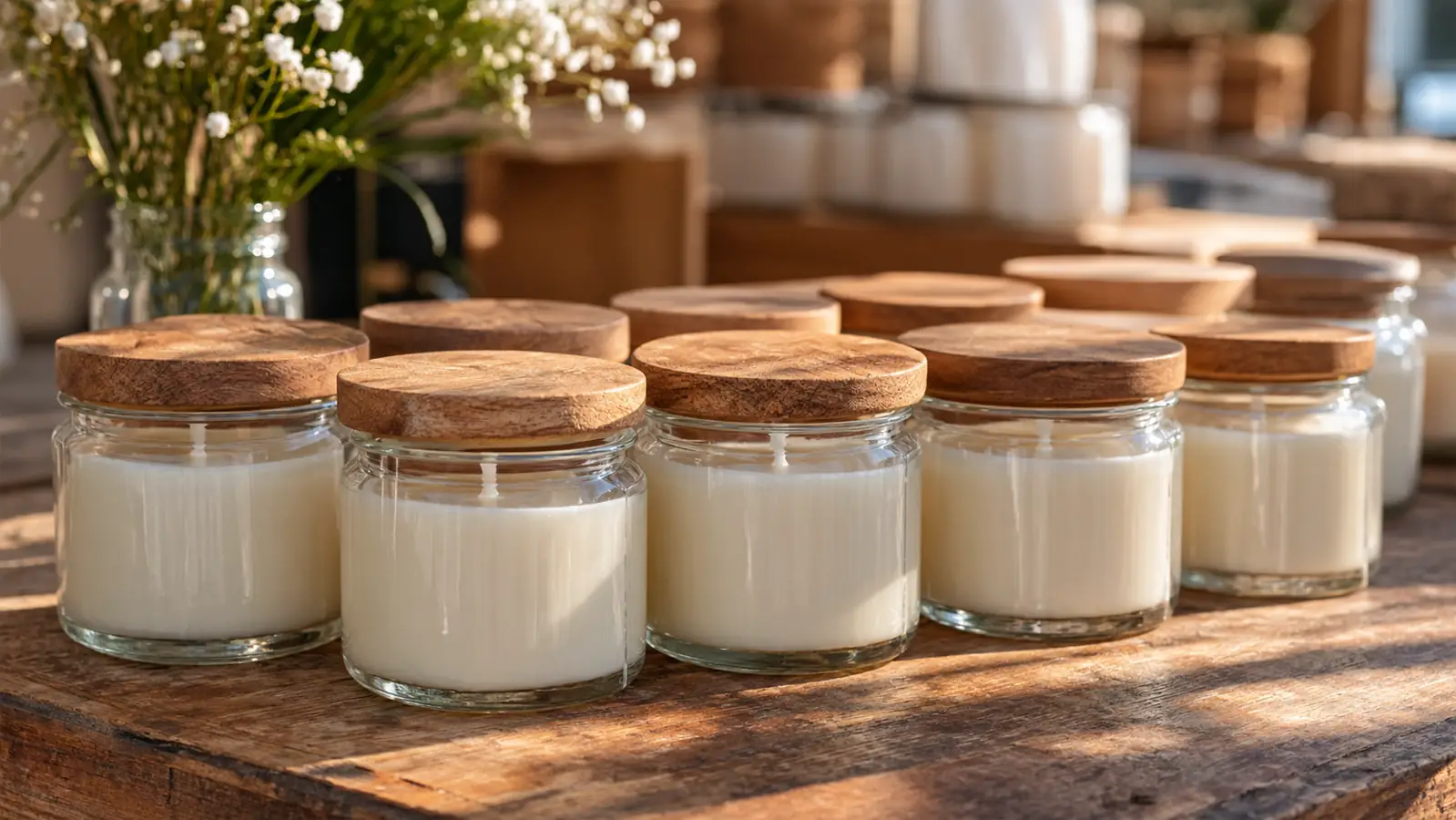
I have been pouring candles in a converted corner of my garage for about four years now, and I have bought a lot of jars that looked better in the listing than they did on my curing shelf. So when I ordered the SHOWIN Candle Jars, I did what I do with every new container: I poured one test candle the night they arrived, let it cure the full two weeks, and burned it down to the last quarter inch before I decided whether the other fifteen were worth my wax.
This is the honest version of that test. The short answer is that these jars are a solid value for a weekend market maker who wants a clean, simple container with a wood lid. The longer answer involves a few things nobody tells you before you buy, and a couple of reasons you might want to pass.
The Quick Verdict
A dependable, good-looking 7 oz jar with a real wood lid, at a price that makes sense for market sellers. Not the thickest glass you can buy, and the lids need a gentle hand, but for a booth that sells soy container candles, these are hard to beat.
Amazon Check Today's Price →A 16-pack of jars that actually looks like the listing
If you are tired of ordering candle jars and hoping, the SHOWIN 16-pack is the kind of boring, reliable purchase that lets you focus on wick testing instead of container roulette.
Amazon Check Today's Price on Amazon →How I Tested These Jars
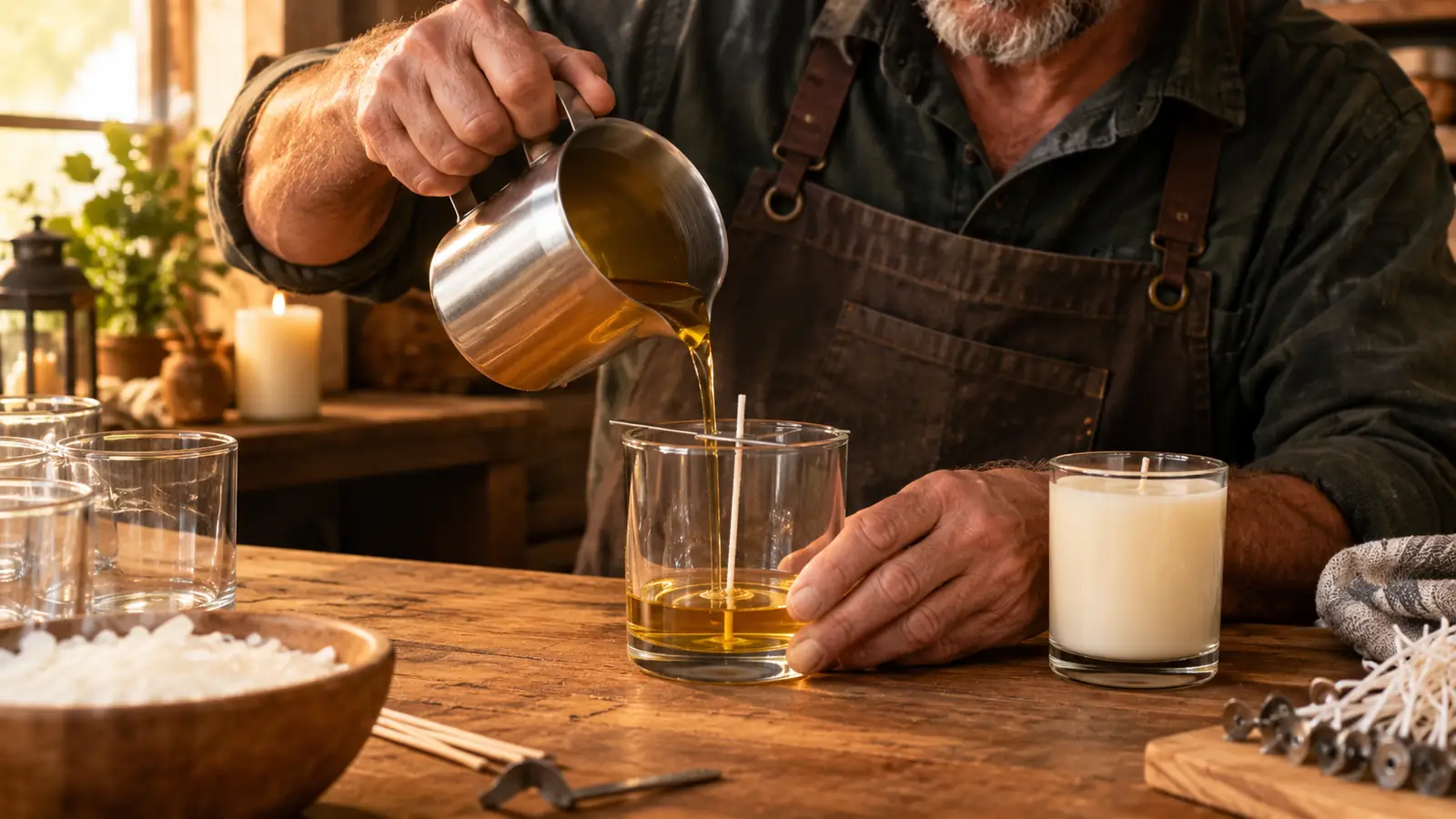
My setup is not fancy. I pour on a long butcher-block folding table in the garage, melt wax on a two-burner electric hot plate, and cure finished candles on a metal utility shelf. For this test I used the same 464 soy wax I use for my market line, a standard cotton wick I had already tested in a similar diameter, and 1 oz of fragrance oil per pound of wax. The box showed up on a Tuesday afternoon in early September, and I had the test jar poured before dinner. I heated the 464 soy wax to 185 degrees, added the fragrance oil at 175, and poured at 135, which is the routine I have settled on after four years of market candles.
I poured one jar the night the box arrived, let it cure for 14 days, and then burned it in two-hour sessions. I also filled a second jar with water to check for leaks, wiped the rim with isopropyl alcohol to see how the glass held up to cleaning, and dropped a third jar onto a folded towel from counter height. That last test is not in any listing, but it is the one that tells you whether a jar will survive a Saturday market bag. The water test sat for a full 24 hours on the butcher block, and the rim wipe was the part I was most curious about, because a rough rim can grab a paper towel and leave fibers in your finished candle. I ran a cotton swab around the inside rim of every jar in the box before I poured anything, and all sixteen came back smooth.
The box arrived with all 16 jars intact, which is not something I can say for every candle jar order I have received. Each jar was wrapped in its own foam sleeve, and the wood lids were packed separately in a plastic bag. No cracks, no chips, no lids that had swollen or split in transit. I unpacked them on the same Tuesday night and checked each jar against the others under the work light. The height matched from jar to jar within a hair.
What Nobody Tells You About the Glass
The listing calls these thick candle jars, and they are thicker than the cheapest straight-sided jars you will find. But thick is a relative word. The glass is noticeably heavier than a mass-market candle jar, and it feels substantial in the hand. It is not, however, the same weight as a premium thick-walled vessel from a specialty glass supplier, and it is not meant to be. I weighed one empty jar on my kitchen scale before I poured anything: it came in at just over 9 ounces, which is about 2 ounces heavier than the straight-sided jars I used for my first two years at the market.
What this means for a market maker is that you get a jar that looks and feels more expensive than it is, without paying specialty glass prices. What it also means is that you should not treat these as indestructible. My drop test onto a folded towel did not break the jar, but I would not want to drop one onto concrete. I also noticed that the glass is slightly thinner at the rim than at the base, which is normal for this style of jar, but worth knowing if you plan to press the lid down hard. I measured the wall thickness at the rim with a cheap set of calipers and got right around 2.5 millimeters; at the base it was closer to 4. That taper is why the jar feels sturdy in the hand but still needs a gentle touch at the top.
One thing I genuinely appreciated: the glass is clear, not green-tinted. A lot of budget jars have a slight green cast that shows up once you pour a light-colored soy candle. These stayed clear through the whole cure, which matters more than you would think when a customer picks up a jar and holds it to the light.
The Wood Lids Are the Best Part and the Most Fragile Part
The wood lids are what sold me on this listing in the first place. A plain glass jar with a metal lid says craft project. A glass jar with a wood lid says small-batch candle company. At a farmers market booth, that difference is worth a lot, because customers decide in the first few seconds whether your table looks like a business or a hobby.
The lids are a light natural wood with a smooth finish, and they fit snugly without needing to be forced. I did not have to sand a single one, which has never happened to me with a budget jar order. The snug fit also means the jars seal well enough to keep dust out during curing, which is a small thing that saves me a lot of wiping before a market. I tested the fit on all sixteen lids the night the box arrived. Every one seated with a soft click and lifted off again without sticking. On an earlier pack of jars from a different supplier, I spent an afternoon sanding eight lids that were too tight, so I know what that job feels like, and I did not have to do it here.
Here is what nobody tells you: the lids are not meant to be used as a candle snuffer. I have seen photos of people placing the lid on top of a burning candle to extinguish it, and the wood will darken and eventually char if you do that regularly. I use a dedicated snuffer at home, and I tell my customers to do the same. The lid is for storage and for looks, not for putting out flames. I tried it once myself on a test candle, just to see how long the flame would take to die. The candle went out in about fifteen seconds, but the underside of the lid came away with a dark ring that would not wipe off.
The other thing to know is that the lids are thin enough to split if you drop them on a hard floor. I dropped one while unloading the curing shelf, and it cracked along the grain. It was my fault, not a defect, but it is worth knowing that these are not heavy-duty lids. If you are rough with your supplies, order a few extra jars just to have spare lids. The crack ran from the edge almost to the center, and I tried to glue it with wood glue that night. The glue held for about a week, then let go when I picked the lid up by the edge.
The wood lids are what sold me on this listing. A glass jar with a wood lid says small-batch candle company, and at a market booth that difference is worth a lot.
How the Burn Test Went
I poured my test candle with a standard cotton wick, and the first burn was clean. The melt pool reached the edges of the jar in about 45 minutes, which is exactly where I want it for a 7 oz container. There was no tunneling, no soot on the glass, and the fragrance throw filled my garage workshop nicely by the second hour. I burned it on a Tuesday evening while I was labeling the next market batch, and I kept a log on a scrap of paper: first burn two hours, second burn two hours, and so on. The first melt pool was about three inches across and shallow, which is the sign of a wick that is not oversized for the container.
By the third burn, the melt pool was staying shallow and even, and the glass was not getting too hot to touch. That is the thing I watch most carefully with a new jar, because a jar that overheats is a jar that cracks. These stayed comfortable through the whole burn, and the wick stayed centered without me having to straighten it. I checked the side of the glass with the back of my hand at the two-hour mark on each burn, and it never got past warm.
The last quarter inch of wax did not fully pool, which is normal for a container candle and not a reason to dock points. I burned it until the wick was too short to light, then cleaned the jar with hot soapy water. The glass cleaned up beautifully, with no waxy film left behind, which means a customer could reuse the jar for a small planter or a makeup brush holder. That is a selling point I mention at the booth, and it is one of the reasons these jars sell well for me. The whole burn cycle ran about 22 hours over nine sessions, and the wick stayed centered the entire time. I have had jars where the wick drifted and left a soot line down one side of the glass, so a clean burn from start to finish is the detail that tells me the diameter is right for this wax.
Who These Jars Are For
These are for the candle maker who sells at one Saturday market, pours in a garage or a spare room, and needs a container that looks professional without costing a small fortune. If you are making soy or coconut-soy candles in the 6 to 8 oz range, the 7 oz size is a sweet spot. It is big enough to look like a real candle, small enough to price affordably, and light enough to carry a dozen of them to a booth without breaking your back.
They are also for the maker who wants a wood lid without paying boutique prices. I have seen the same style of jar at craft supply stores for nearly double the per-jar price of this pack. For a weekend operation, that difference adds up fast, especially when you are buying jars in bulk a few times a year.
Who Should Skip These
If you are pouring candles as a serious side business with plans to scale to wholesale or online sales, you will probably want a thicker, more consistent jar from a dedicated glass supplier. The SHOWIN jars are great for a market booth, but they are not a commercial-grade container. The glass is not perfectly uniform from jar to jar, and a wholesale buyer will notice that kind of thing. I measured the rims on all sixteen jars and found a hair of variation between the widest and the narrowest, nothing that matters at a market booth, but the kind of thing a wholesale order gets checked for.
You should also skip these if you need a jar that can survive rough shipping. The jars arrived perfectly packed, but they are not shatterproof. If you are shipping candles to customers, you will need to wrap each one carefully, and you should factor in the cost of extra packing materials. For my market booth, that is not a concern. For an Etsy shop, it would be.
And if you are looking for a jar with a colored or painted finish, these are not it. The whole appeal is the clear glass and the natural wood lid. If your brand needs a pop of color, you will be adding your own labels or painting the lids yourself.
What I Would Change
If I could change one thing about the SHOWIN Candle Jars, it would be the lid thickness. The lids look great and fit well, but they are thin enough that I worry about them splitting if a customer is rough with them. I have started telling customers to lift the lid by the edges rather than prying it off, which is not something I should have to say about a well-made lid.
I would also love to see the jars sold in a smaller pack for first-time buyers. Sixteen jars is a commitment if you are just trying a new container. I bought the 16-pack because I was already confident in my wax and wick setup, but if you are new to candle making, you might want to start with a smaller quantity before committing to a full box.
What I Liked
- Real wood lids that fit snugly and look far more expensive than they are
- Clear glass with no green tint, so light-colored soy candles look clean
- Sturdy enough for a market booth, with all 16 jars arriving intact
- Cleans up easily, so customers can reuse the jar after the candle is gone
- Good value for a weekend maker who wants a professional look without boutique prices
Where It Falls Short
- Lids are thin and can split if dropped on a hard floor
- Glass is not as thick as premium specialty jars
- Not ideal for shipping candles without heavy extra packing
- Slight variation between jars, which wholesale buyers may notice
The Bottom Line
I have poured a lot of candles in four years of Saturday markets, and I have learned that the container is half the sale. A good candle in a bad jar sits on the table. A good candle in a jar that looks like it came from a small-batch studio sells out. The SHOWIN Candle Jars are the second kind of jar.
They are not the thickest glass you can buy, and the lids need a gentle hand. But for a weekend market candle maker who wants a clean, professional look at a price that makes sense, these are a dependable choice. I have already ordered a second box for my next pouring session, and I expect I will order a third.
The jars I keep coming back to
If you are ready to try a container that looks like a small-batch studio pour without the boutique price, the SHOWIN 16-pack is a safe bet. My second box is already on my curing shelf.
Amazon Check Today's Price on Amazon →