

If you pour candles at home, you have probably stood in the wax aisle wondering the same thing I did for two years: should I spend the money on a fragrance oil set, or stick with essential oils because they sound more natural? I am Marla Quinlan, and I have been making soy and coconut-soy container candles in a converted corner of my garage outside Chattanooga for about four years. I sell at one Saturday farmers market booth, and I have tested both scent paths with the same wax, the same wicks, and the same cure times. The short answer: Fiora Naturals fragrance oils win for most home candle makers, but not for the reason you might think.
It is not that essential oils are bad. It is that they are a different tool for a different job. If you want a candle that fills a living room and smells the same on day 30 as it did on day 3, a Fiora Naturals fragrance oil set is the practical choice. If you want a subtle, botanical scent and you are willing to accept a shorter throw and a higher ingredient cost, essential oils can work. Here is the honest breakdown from my own pours.
| Fiora Naturals Fragrance Oil Set | Essential Oils | |
|---|---|---|
| Scent strength in soy wax | Strong cold and hot throw at 8 to 10 percent fragrance load | Noticeable cold throw, weaker hot throw, fades faster |
| Scent consistency | Same batch profile bottle after bottle | Varies by harvest, season, and supplier |
| Cure time | Usable in 3 to 5 days, better at 7 | Often needs 10 to 14 days to settle |
| Cost per candle | Lower cost per ounce, a little goes further | Higher cost per ounce, needs more to get any throw |
| Natural ingredients | Fragrance oils, not a natural product | Plant derived, the more natural choice |
| Scent range | Dozens of bakery, floral, and woodsy options | Limited to what the plant gives you |
| Best for | Container candles, wax melts, and market booths | Small batches, personal use, subtle scents |
Where Fiora Naturals Wins
The biggest difference shows up in the hot throw. I poured two identical 8 ounce soy candles, one with a Fiora Naturals fragrance oil at 9 percent and one with an essential oil blend at the same percentage. After a five day cure, I burned them in the same room, same time of day, same window position. The Fiora Naturals candle scented the whole room within about 20 minutes. The essential oil candle smelled lovely when I put my nose near it, but from across the room it was a whisper. That matters when you are trying to sell candles at a booth where a customer decides in the first few seconds whether to pick one up.
Consistency is the second win. I have bought the same essential oil from the same supplier twice and gotten two different scent profiles because the harvest changed. Fiora Naturals blends are made to a fixed formula, so the bottle I open in March smells like the bottle I opened in November. For a small business, that predictability is worth more than the word natural on a label. My repeat customers expect the same scent from the same candle name, and fragrance oils deliver that.
Here is how that test actually ran, because the details are where most comparisons fall apart. Both candles used the same soy wax from the same bag, the same pre-waxed cotton wick, and the same 8 ounce straight-sided jar. I added the oil at 185 degrees, stirred for a slow two minutes, and poured at 135. Both cured for ten days on the metal shelf in my garage. Then I burned each one for three hours in our back bedroom with the door shut, and Dale walked in at the one-hour and three-hour marks without being told which candle was which. He picked the Fiora Naturals candle as the stronger one both times, and he does not care about candles at all, which makes him a pretty good judge.
The essential oil candle was not scentless. It just faded. At the one-hour mark Dale said he could smell something lemony near the dresser. At three hours he said the room smelled like warm wax. When I sniffed the jar itself, the scent was still there in the melt pool, but it was not reaching the doorway. That is the pattern I have seen over and over with essential oils in soy: a decent cold throw, a weak hot throw, and a candle that smells best when it is not lit.
Want a scent that actually fills the room?
The Fiora Naturals fragrance oil set gives home candle makers a strong, consistent hot throw without the guesswork of essential oils. Check today's price on Amazon and see the scent list for yourself.
Amazon Check Today's Price on Amazon →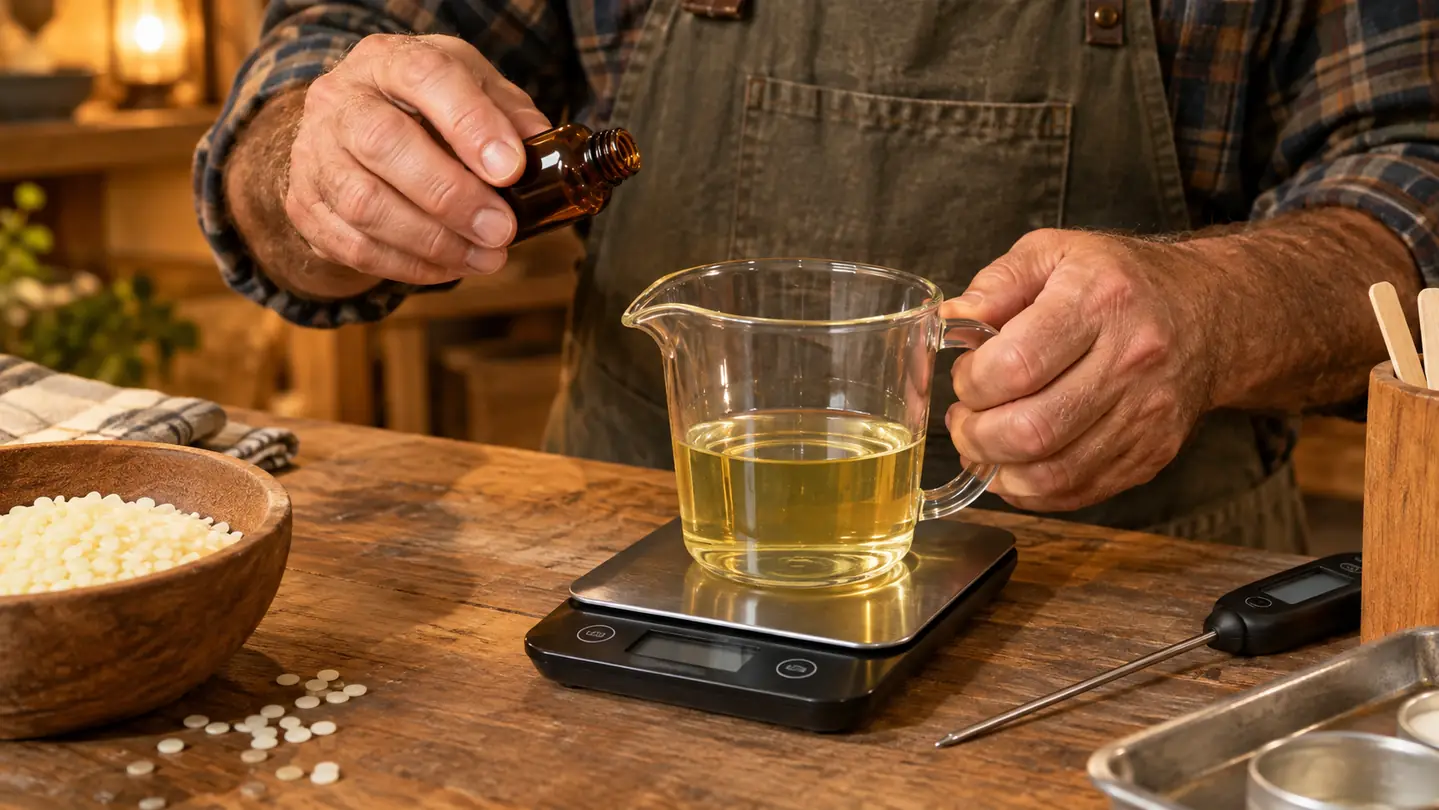
Where Essential Oils Win
I am not going to pretend essential oils lost every round. If your priority is a plant derived ingredient list, essential oils are the honest choice. Some customers specifically ask for them, and I keep a small line of lavender and eucalyptus candles for those buyers. The scent is cleaner and more botanical, and there is a segment of the market that will pay a little more for that story. If you sell at a market where customers read labels carefully, that can matter.
Essential oils also win on subtlety. A fragrance oil can be loud, sometimes too loud in a small room. An essential oil candle gives off a gentler scent that some people prefer for bedrooms or bathrooms. The tradeoff is that you need a longer cure time, usually 10 to 14 days, and you need to test each oil individually because some scorch or fade at normal candle temperatures. I have had lavender throw beautifully and lemongrass disappear entirely by the second burn. That is the reality of working with a natural product.
The other honest win for essential oils is the customer who asks for them by name. At my booth I get maybe one or two people a month who pick up a candle, turn it over to read the label, and ask whether it is made with essential oils. Those shoppers are not wrong to ask, and they are not going to be talked out of it. For them I keep a small run of lavender and eucalyptus candles made with essential oils, labeled as a lighter scent, and I tell them plainly that these will be softer in the room. Being upfront about that has kept every one of those customers happy.
Just know what you are signing up for. Many essential oils evaporate quickly at the temperatures wax needs, so a lot of what you pay for can flash off before the candle ever sets. Some of the citrus oils also have low flash points, which means you have to add them cooler and watch your thermometer closely. And plenty of essential oils are skin irritants at full strength, so gloves are not optional when you handle them.
How I Tested Both
I did not want this to be a vibes comparison, so I set up a simple test I could repeat. Over about six weeks I poured twelve test candles in the garage: six with oils from the Fiora Naturals set and six with single-note essential oils I already had on the shelf, lavender, sweet orange, eucalyptus, peppermint, lemongrass and cedarwood. Every candle used the same soy wax, the same wick size, the same jar and the same thermometer. I wrote the pour temperature, the oil load and the date on a strip of masking tape on the bottom of each jar.
I kept the fragrance oil candles at 8 to 9 percent, which sits comfortably inside the range most soy wax suppliers list. For the essential oils I started at 6 percent and worked up, because pushing essential oils too high in soy can cause sweating and an oily surface, and because the cost adds up quickly. Every candle cured at least ten days before I lit it. Then I burned them in pairs in the same small room, one fragrance oil candle against one essential oil candle with a similar scent family, and I took notes at the one and three hour marks.
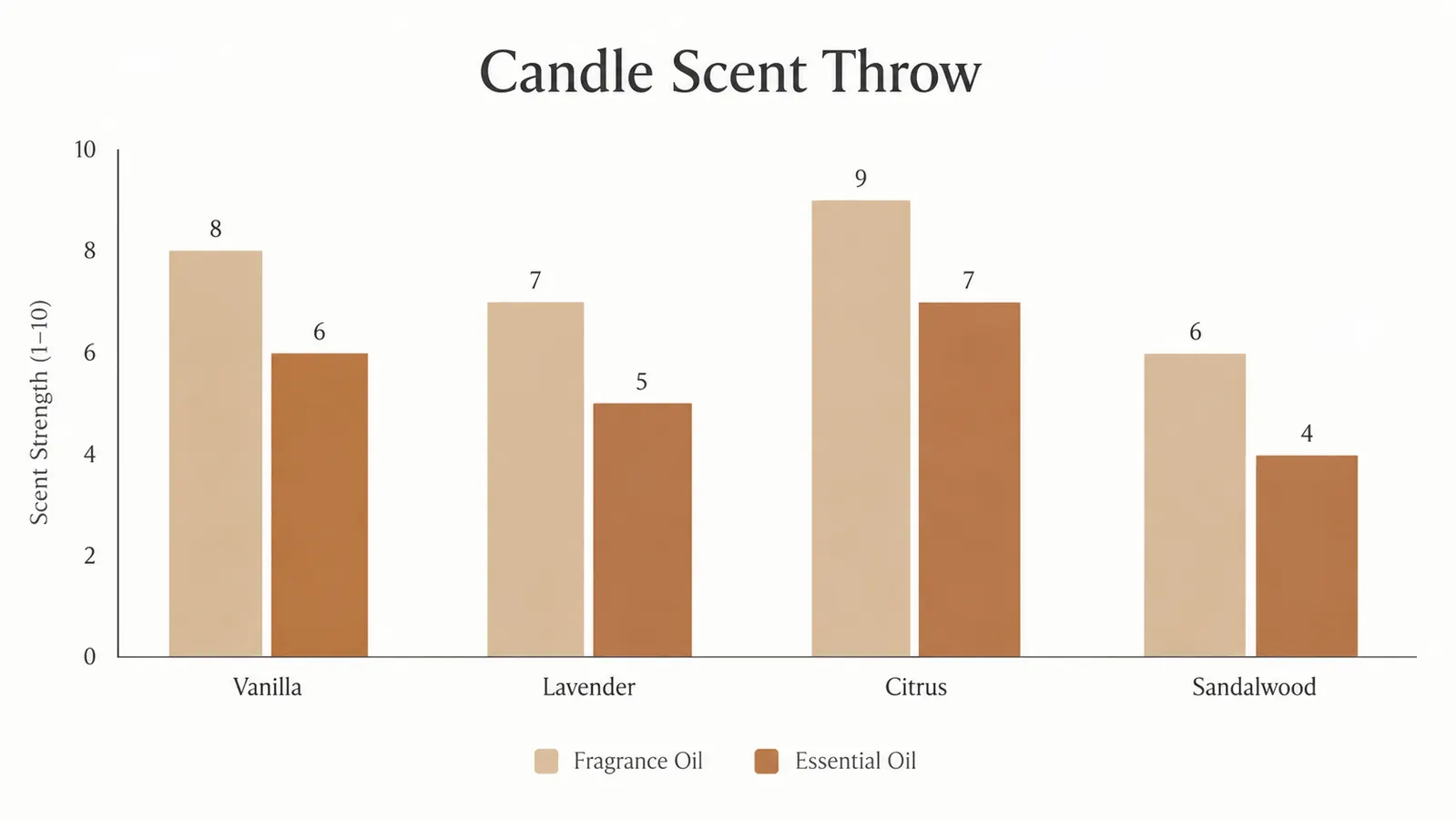
The result was not close for throw. Five of the six Fiora Naturals candles filled the room by the one-hour mark. Only the eucalyptus essential oil candle came near that, and it faded by hour three. The lavender and the sweet orange were pleasant up close and nearly gone from across the room. That matches what other home candle makers tell me at the market, so I do not think my garage is unusual.
Safety and Handling Differences
Fragrance oils made for candles are blended to hold up in hot wax, and a reputable supplier publishes the flash point and a maximum recommended load for each scent. That gives you numbers to work with. I add fragrance below the flash point, keep the thermometer in the pot, and never go over the listed load just because I want a louder candle. More oil does not always mean more throw; past a certain point it simply sweats out of the wax.
Essential oils give you less to go on. Flash points vary widely from oil to oil, and the bottle in a craft store rarely lists one. Some are known skin and eye irritants, and a few are not considered safe around pets or small children in a closed room. None of that means you cannot use them, but it does mean you should read up on each oil before it goes in a candle you plan to gift or sell, and keep the burning candle in a ventilated space. Whichever oil you use, wear gloves, wipe up drips right away, and store the bottles where little hands cannot reach them.
One practical note for anyone selling: label what is in the candle honestly. If it is a fragrance oil, do not call it all natural. If it is an essential oil blend, say so, and say it will be lighter. Customers remember a candle that matched its label far longer than they remember a clever name.
Cost is the last piece, and it is easy to underestimate. Because essential oils need a higher load to be noticed at all, and because so much of them flashes off in hot wax, a single essential oil candle can use a surprising share of a small bottle. A fragrance oil set like the Fiora Naturals one stretches further: at my usual load, one small bottle scents a full tray of 8 ounce jars, and the set gives me a dozen scents to rotate through the seasons. For a small booth that has to keep a steady range on the table, that difference matters more than any single test.
My own setup today is simple. The Fiora Naturals oils carry the main line, the candles I make in batches of a dozen and restock every couple of weeks. Essential oils get their own small labeled shelf for the shoppers who ask. Keeping the two clearly separated has stopped me from mixing up batches and has made the labels easy to write.
Who Should Buy Which
Buy the Fiora Naturals fragrance oil set if you make candles for gifts, for a market booth, or for anyone who expects a strong scent the first time they light it. Buy essential oils if you are making small batches for your own home, if you want a subtle botanical scent, or if a plant derived ingredient list is a hard requirement for your brand. There is room for both on the same shelf. I use Fiora Naturals for most of my line and keep a small essential oil collection for the customers who ask.
If you are new to candle making, start with the fragrance oil set. It is more forgiving, cures faster, and gives you a wider range of scents to test while you figure out your wick sizes and wax preferences. Once you know your process, you can experiment with essential oils for a specialty line. That is the path I wish someone had laid out for me when I started.
Start with the set that works every time
Fiora Naturals fragrance oils are the dependable choice for home candle makers who want strong, consistent scent throw. See today's price on Amazon and compare the scent options before you pour your next batch.
Amazon Check Today's Price on Amazon →