

Freedom Soy Wax, from American Soy Organics, carries more than 21,000 ratings on Amazon and a 4.8-star average. That is a lot of people pouring the same five-pound bag that sits on my garage shelf. The ratings are not wrong, and I am not here to argue with them. But a star average does not tell you what the first few months of using this wax actually feel like. It does not tell you about frosting, sinkholes, or cure time. It does not tell you which wicks to buy or what temperature to pour. This is the review I wished I had read before I bought my first bag, written from a butcher-block table in a converted garage in Tennessee.
I am Marla Quinlan. I have sold candles at one Saturday farmers market booth for about four years, never a storefront and never a second market. I pour mostly soy and coconut-soy container candles, and I work with a two-burner electric hot plate because it fits my corner of the garage better than anything bigger. I am not a chemist, and I do not have a sponsored studio. I am someone who has melted, poured, cured, and burned a lot of this wax, and I want to give you the version of the story that the product page leaves out.
The Quick Verdict
A dependable container wax that rewards patience. Expect a learning curve, some cosmetic frosting, and a full week of cure time before you judge it. I keep coming back to it.
Amazon Check Today's Price →The short version: this is the container wax I keep coming back to.
It pours smoothly, holds scent well for a natural wax, and it is forgiving enough for a weekend operation like mine. See today's price on Amazon and decide whether it fits your setup.
Amazon Check Today's Price on Amazon →How I've Used It
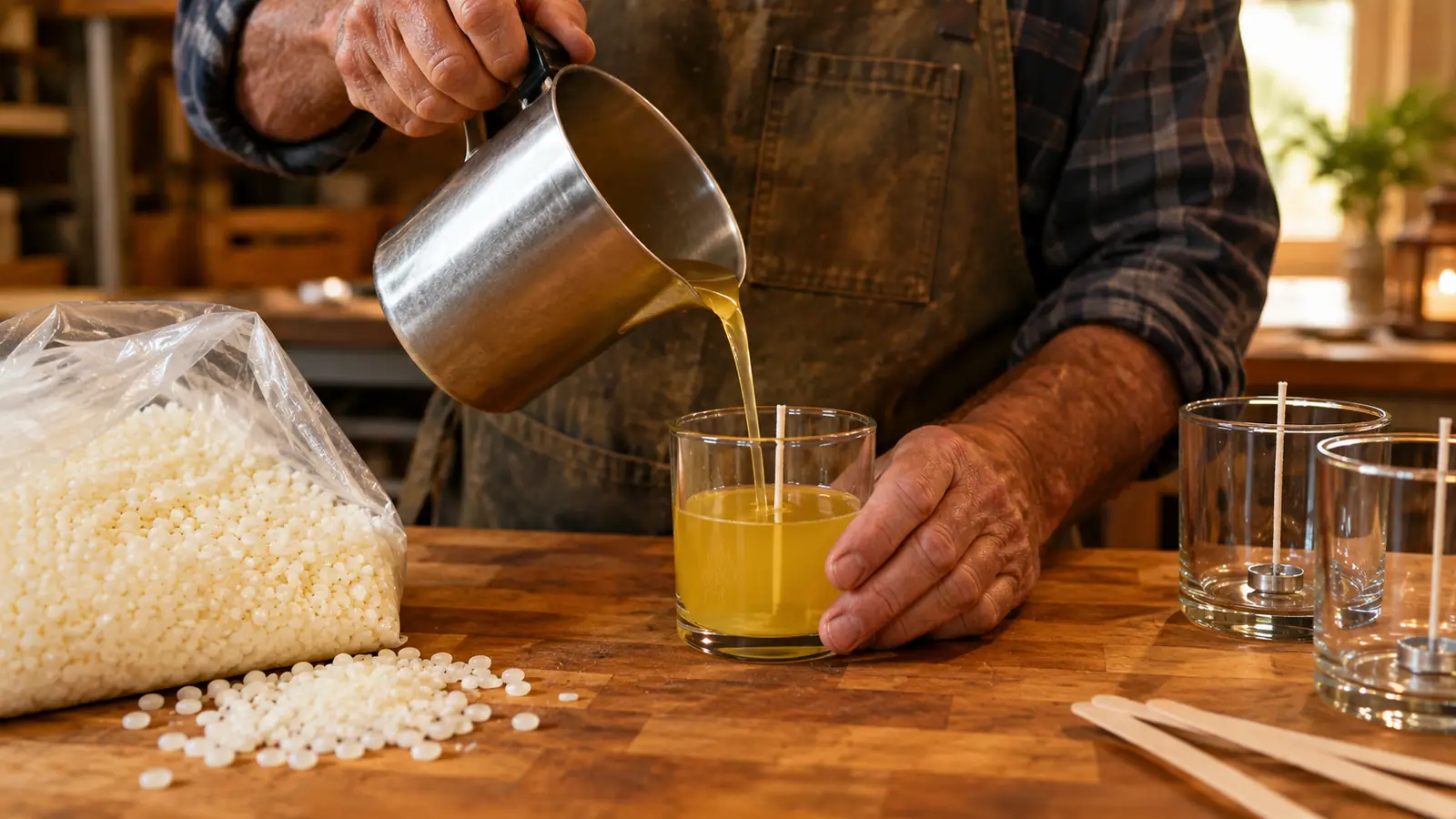
My routine has not changed much in the years I have used this wax. I melt the beads on my hot plate in a pour pot, starting with medium heat and stirring now and then until the wax is fully liquid. I heat it to about 185 degrees Fahrenheit, add my fragrance oil at that point, stir for a couple of minutes, and then let it cool to around 135 degrees before I pour. That last step is the one people skip, and it is the one that causes most of the problems.
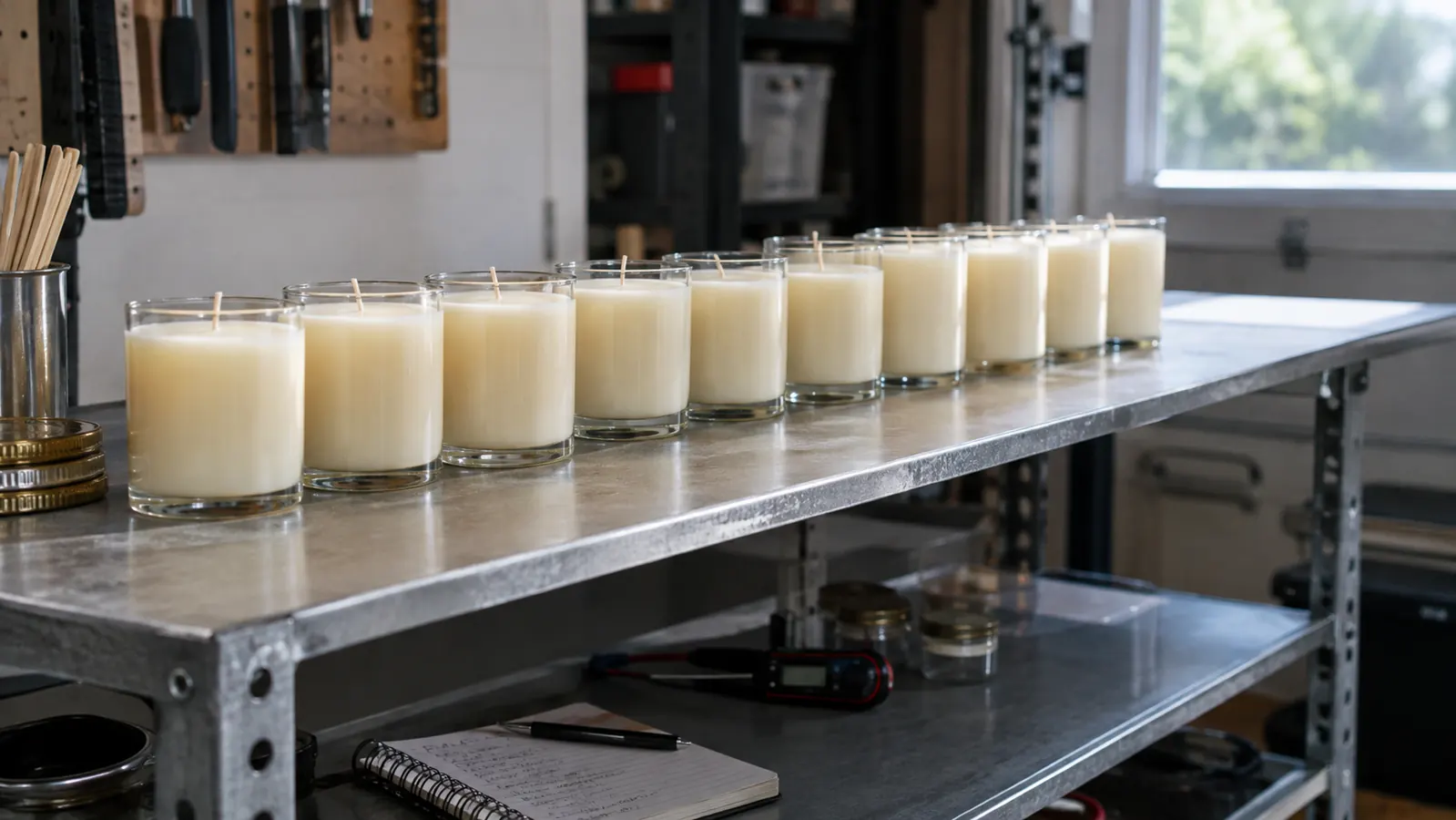
I pour into standard 8-ounce glass jars, and I have learned to leave the candles alone for at least a week before I light one. The first time I used this wax, I burned a candle the next day and thought the scent was weak. A week later, the same recipe smelled like a different candle. That cure time is not a marketing line. It is the difference between a good candle and a so-so one.
I also test wicks for every new jar size, because this wax behaves differently from the coconut-soy blend I sometimes use. The same wick that works fine in one blend can tunnel in this one. I keep a small notebook on my utility shelf with wick sizes, pour dates, and results, and it has saved me more batches than I can count. I pour in batches of six to twelve jars, depending on what is coming up at the market, and I keep a pour pot dedicated to this wax and a second one for my coconut-soy blend. The routine is boring on purpose. Consistency is what sells candles.
What the Product Page Does Not Tell You
Start with frosting. Soy wax, including this one, develops a patchy, crystalline look on the surface as it cools and cures. Some batches come out smooth, and some look like the top of an old farmhouse table. It is cosmetic, it does not affect how the candle burns, and most customers at my booth have never mentioned it. But if you are pouring candles as gifts or selling them, you should know it happens even when you do everything right.
The product page also does not tell you about sinkholes. When hot wax cools, it can pull away from the wick and leave a crater around the base. My fix is to keep back a little melted wax from each batch and top off the jars after the first few hours of cooling. That is normal work with soy, not a defect in this particular bag, but it is work nobody mentions in the reviews.
And then there is the cure time. Most of the negative reviews for this wax are really negative reviews for impatience. People pour, burn the next morning, and then complain that the scent is faint. Give the candle a full week on the shelf before you judge it. That is the single biggest piece of advice I can give you, and I will say it again before this review is over.
One more thing the reviews skip: this wax stores well, but it has opinions about where you keep it. I keep my bags on the metal utility shelf in the garage, away from direct sun and off the floor. In the summer, when the garage gets warm, the beads can soften and clump. That is not a defect. Let the bag sit in a cooler spot for a day and the beads break apart again with a gentle squeeze.
Scent Throw: The Honest Version
The honest version of scent throw with American Soy Organics Freedom Soy Wax is this: it is good, not loud. Soy wax carries fragrance differently from paraffin. You get a cleaner burn and a slower, steadier release, but you do not get the immediate hit that some paraffin candles give you. If you are used to mass-market candles, your first soy pour might feel quiet by comparison.
I use about one ounce of fragrance oil per pound of wax, which is a moderate load, and this wax handles it well without sweating. Cold throw, the scent you smell before lighting, is there but gentle. Hot throw, the scent while burning, is where the candle earns its place at the market. In a small room, one of my 8-ounce candles will scent the space in about twenty minutes.
One thing I have learned the hard way: fragrance oils vary, and this wax will not rescue a weak oil. If you buy cheap fragrance oil, you will get a cheap-smelling candle, and that is not the wax's fault. Use a quality oil from a supplier you trust, measure it by weight, and write down what you used so you can repeat it. Good wax is only half of a good candle.
I keep the same notebook for scent tests that I use for wicks. I write down the oil, the percentage, the pour date, and a note about the hot throw on day three and day seven. It sounds fussy, but it is the only way I have found to compare batches honestly. Memory lies after a month of pouring; notes do not.
What the Reviews Get Right and Wrong
I read a lot of the reviews before I wrote this, because I wanted to see whether my experience matched everyone else's. The five-star reviews mostly get it right: the wax melts clean, has no smell of its own, and makes a decent container candle. The one-star reviews mostly fall into two camps, and neither camp is really about the wax.
The first camp is people who expected paraffin performance. They wanted a strong, aggressive hot throw, and soy gave them something gentler. That is a real difference, and if that is what you want, you should buy a different wax. The second camp is people who skipped the basics. They poured too hot, used the wrong wick, burned the candle too early, and then blamed the bag.
There is a smaller third group, and I take these seriously: people who got a batch that frosted heavily or threw their scent weakly even after a proper cure. Natural wax is a farm product, and batches vary. It has happened to me, and when it does, I adjust my pour temperature and move on. If you need identical results every single time, natural wax will frustrate you.
The Learning Curve Nobody Mentions
My first batch with this wax was a mess. I poured too hot, the jars cracked a little at the bottom, and the tops looked like a frozen pond someone had walked across. I blamed the wax for about an hour, and then I blamed myself, and then I went back and read the basics again. The wax was fine. My process was the problem.
The learning curve has three parts. First, pour temperature matters more than you think. Too hot causes sinkholes and cracking. Too cool causes a lumpy surface and poor adhesion to the jar. Second, wick selection is not guesswork. I test at least two wick sizes for every new jar, and I burn each test candle all the way down to see how the melt pool behaves. Third, your room temperature changes the result. I pour in a garage in Tennessee, which means my summer candles behave differently from my winter ones.
None of this is unique to American Soy Organics. Every natural wax has a learning curve, and this one is actually on the easier end. The beads melt evenly, they do not smell like anything on their own, and the wax plays nicely with a basic pour pot and a kitchen thermometer. If you are coming from paraffin, budget a few test batches before you judge the wax.
I will tell you what I tell every new maker who stops by my booth: start small. Buy one bag, pour a few test candles, and do not sell anything until you have burned it yourself. A candle that tunnels or drowns its wick is not a candle you want to hand to a paying customer. The wax will not save you from a bad test, and the test will not take as long as you think.
Give the candle a full week on the shelf before you judge it. Most of the bad reviews for this wax are really reviews of impatience.
Where It Falls Short
Now the part that nobody puts in a five-star review. This is a container wax, and it knows it. It is not a good choice for molded candles or pillars. If you want to make freestanding candles, buy a pillar wax or a blend designed for that job, and do not fight this one into a mold. I make beeswax pillars in the winter for exactly that reason.
The frosting is the other honest drawback. Some people genuinely do not care, and most of my market customers do not notice. But if you are pouring candles for a wedding or a gift table, and you need a flawless surface on every single jar, soy wax will occasionally disappoint you. You can manage it with careful pour temperatures and a heat gun, but you cannot eliminate it entirely.
The five-pound bag is also a small size for anyone pouring seriously. I go through a bag quickly on a busy market week, so I buy larger quantities when I can. That is not a knock on the product. It is just something to know before you order one bag, fall in love with it, and then realize you are reordering every two weeks.
What I Liked
- Melts evenly and pours smoothly with basic equipment
- Clean burn with minimal soot and a steady scent release
- Forgiving cure time; a full week makes a noticeable difference
- Good value for small-batch makers who do not want to commit to bulk
- No waxy smell of its own, so fragrance oils come through clearly
Where It Falls Short
- Frosting appears on some batches no matter what you do
- Container wax only, not for pillars or molded candles
- Sinkholes can form if you pour too hot; you will need a top-off step
- Requires real wick testing and patience before the first good batch
- Five-pound size goes fast for anyone pouring every week
Who This Is For
American Soy Organics Freedom Soy Wax is for the home candle maker who wants a dependable container wax and is willing to learn the craft. It is for someone pouring for their own kitchen, for gifts, or for a small market booth like mine. If you are comfortable testing wicks, waiting a week to cure, and accepting the occasional frosted top, this wax will serve you well.
It is also for people who care more about consistency than about the name on the bag. My customers do not ask what brand of wax I use. They ask whether the candle smells good, how long it burns, and whether the jar looks nice on a shelf. What this wax gives me is predictability: the same recipe, the same pour, the same cure, and the same burn, week after week.
And if you are the kind of person who enjoys the craft itself, the testing and the waiting and the tiny adjustments, you will get along with this wax fine. It does not demand perfection on the first pour. It rewards people who show up and try again.
Who Should Skip It
Skip this wax if you need perfect, glass-smooth tops on every candle, or if you want to pour pillars and molded shapes. Skip it if you are not willing to test and learn, because no wax will fix a rushed pour. And if you want an aggressive, room-filling hot throw that hits you the moment you walk in, you may prefer a paraffin or paraffin-soy blend. Those are fair reasons to choose something else, and none of them mean this wax is bad.
Ready to pour your own test batch?
The honest review is done, and the bottom line is simple: this is a solid container wax that rewards patience. It melts, it pours, it cures, it burns, and it sells, and it is the reason I keep a bag of American Soy Organics on my shelf even though I also use a coconut-soy blend. Check today's price on Amazon and start with one bag before you commit to more.
Amazon Check Today's Price on Amazon →